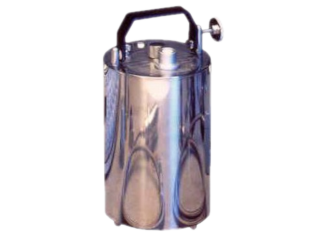
Sensonics Willmore MkIIIA/E3 geophysical sensor
Sensonics Willmore MkIIIA/E3 geophysical sensor - Robust, industrial-grade, electrodynamic geophysical sensor (e.g. for seismic observation of geological structures) 1500 V//ms-1, max. 0.007 mm/s, 0.1 Hz ... 150 Hz, built-in amplifier version, built-in connector cable (side)
Properties
- electrodynamic, direct signal output or with built-in amplifier
- applicable in any measurement direction
- durable, easily transportable design
- hermetic weatherproof stainless steel housing
- filtered frequency range 0.1 Hz ... 150 Hz
- vibration velocity output
- adjustable period time 1 ... 3 seconds
- adjustable damping (up to 8 times critical)
- sensitivity 400 V/m*s-1 ... 1500 V/m*s-1
- two types of electrical connections: built-in cable or Fischer connector (top)
- operating temperature range -40°C ... 50°C, with built-in amplifier 0°C ... 50°C
Description
Sensonics Willmore MkIIIA/E3 geophysical sensor - The Sensonics-manufactured Willmore MkIIIA electrodynamic seismic vibration sensor can be applied in any location, altitude, and measurement direction. Its stainless steel housing protects the sensor from mechanical and magnetic field influences. The robust, durable, hermetic construction allows for application even in harsh conditions.
The MKIIIA/S type is an electrodynamic vibration velocity sensor suitable for both free-field and laboratory use. The seismic mass itself is a permanent magnet, secured with ribbon springs to perform axial motion freely while being constrained in other directions. In the case of vertical application, the mass of the magnet is counterbalanced by springs cleverly attached to the frame, minimizing stiffness influence on axial motion. In horizontal application, the springs do not come into contact with the mass. The output signal is generated in coils located in the frame at both ends of the mass. Auxiliary coils are used for feedback and calibration. The natural frequency of the mass is adjustable, allowing optimization of the sensor for specific operational conditions. Optionally, the MKIIIA can be supplied with three types of built-in - low-power - amplifiers, with the advantage that the amplifier placed in the sensor housing is least sensitive to external interference. The adjustable electronic damping not only provides noise reduction through technology but also enables users to apply the sensor for measurements ranging from micro-seismic events to strong movements. DC offset fluctuation is practically eliminated through feedback control, which also acts as a low-frequency filter. The feedback can be emphasized to achieve a long-period sensor characteristic in the frequency response. Each built-in amplifier provides different characteristics to the sensor, making it suitable for different tasks. The E1 option is specifically optimized for minimal energy consumption compared to the E2 standard amplifier, while the E3 option aims for the lowest noise level (with slightly higher energy consumption). All sensors are overdamped and can be easily adjusted to the required damping factor. Since the damping is electronically controlled, the damping amplifier can be cut to set long and short-period seismic sensor characteristics. Moreover, customer-specific response functions can also be manufactured.